The "China Plus Many" Playbook: De-Risking Your Supply Chain

The "China Plus Many" Playbook: De-Risking Your Supply Chain in an Age of Geopolitical Fracture
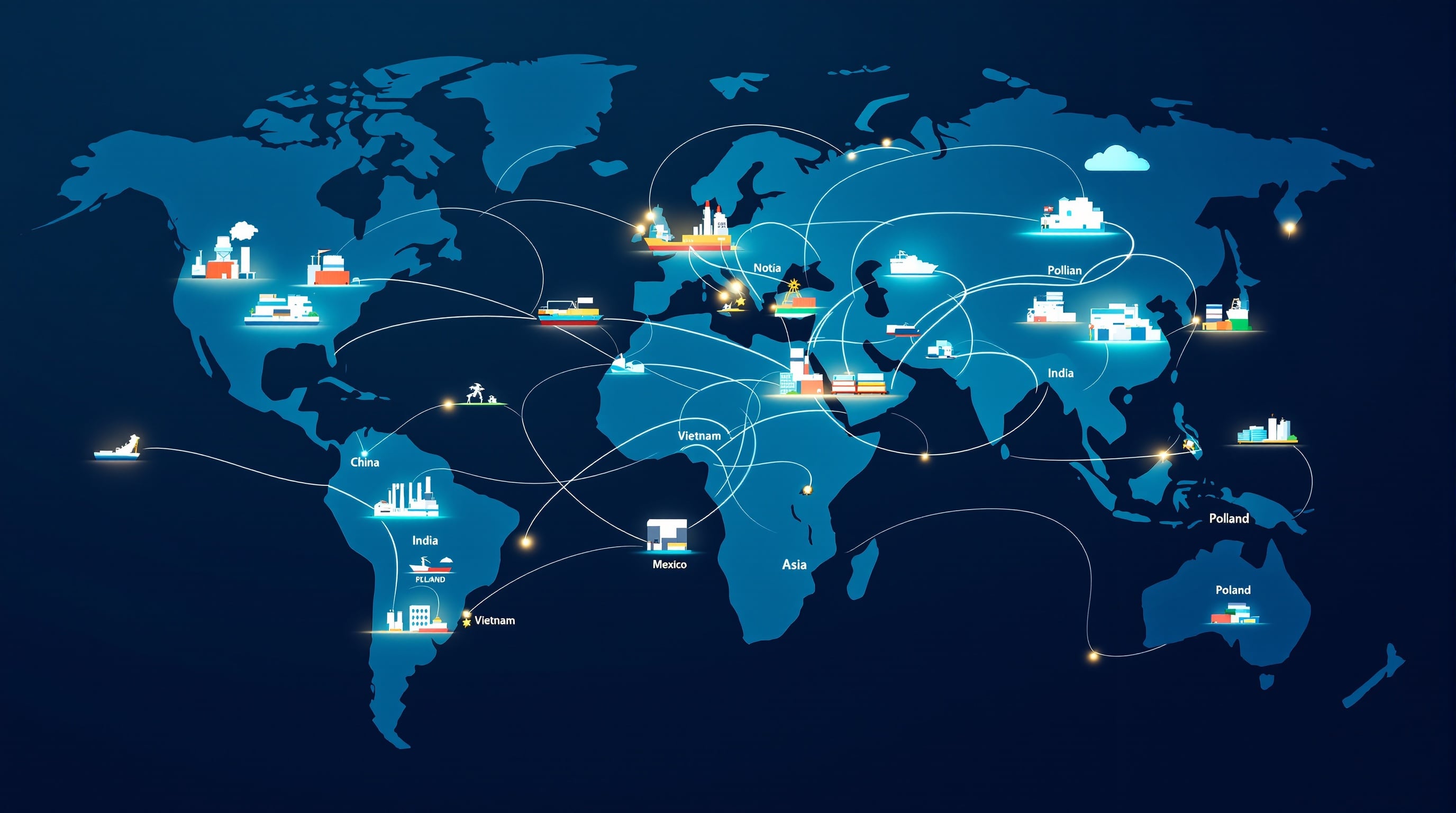
The era of putting all your manufacturing eggs in one basket is over. When Red Sea shipping attacks disrupted global logistics in early 2026, or when U.S.-China tariff tensions spiked semiconductor costs by double digits, the message became crystal clear: supply chain concentration is a strategic liability. For procurement professionals and supply chain executives, the question is no longer whether to diversify, but how to execute a "China Plus Many" strategy that balances resilience with operational reality.
This isn't about abandoning China—it remains the world's largest manufacturing ecosystem. Rather, it's about building a distributed network that can withstand geopolitical shocks, regulatory shifts, and the inevitable disruptions of an increasingly volatile world.
Why "China-Only" Is No Longer Viable: The Macroeconomic Drivers
The strategic imperative to diversify stems from multiple converging pressures that have fundamentally altered the risk-reward calculus of concentrated sourcing.
Geopolitical fragmentation tops the list. The U.S.-China relationship has evolved from trade partnership to strategic competition, with tariffs, export controls on semiconductors and AI technology, and national security reviews of supply chains becoming the new normal. China's share of U.S. imports fell from 22% in 2017 to 16% in 2022, a trend that continues to accelerate. The potential for conflict over Taiwan—which produces over 60% of the world's semiconductors—represents an existential threat to global technology supply chains.
Trade policy volatility has made long-term planning nearly impossible. Tariff rates can shift with political winds, and what's compliant today may be sanctioned tomorrow. The Uyghur Forced Labor Prevention Act and similar regulations have added layers of due diligence that make single-country sourcing increasingly risky from a compliance standpoint.
The COVID-19 pandemic served as a brutal stress test, exposing the fragility of just-in-time systems built on the assumption of uninterrupted supply. Over 90% of North American manufacturing companies relocated at least some production from China between 2018 and 2023, according to Boston Consulting Group research.
Finally, rising labor costs in China have eroded the pure cost advantage that once made concentration economically rational. Chinese manufacturing wages have increased substantially over the past decade, narrowing the gap with emerging alternatives and making the risk premium of diversification more palatable.
Understanding the "China Plus Many" Model
"China Plus Many" is not reshoring, and it's not a complete exit from China. It's a deliberate strategy to maintain a presence in China while establishing parallel capabilities in multiple alternative locations. Think of it as portfolio diversification applied to manufacturing.
The model recognizes that no single country can replicate China's unique combination of scale, infrastructure, supplier ecosystems, and skilled labor. Vietnam excels in electronics and textiles but lacks China's raw material processing capacity. India offers a massive workforce and growing tech capabilities but faces infrastructure bottlenecks. Mexico provides nearshoring advantages for North America but at higher labor costs than Asia.
The strategic framework involves three key decisions:
- What stays in China? Typically, high-volume, mature products where China's ecosystem advantages remain unmatched, or products serving the Chinese domestic market.
- What moves, and where? High-risk, geopolitically sensitive items (like defense-related components) or products where speed-to-market justifies nearshoring costs.
- What gets dual-sourced? Critical components that warrant the complexity and cost of qualifying multiple suppliers across different geographies.
Comparative Analysis: Emerging Manufacturing Hubs for 2026
Southeast Asia: Vietnam, Thailand, and Indonesia
Vietnam has emerged as the standout winner in electronics and footwear. Its manufacturing sector grew from 24% to 30% market share in key categories between 2023 and 2025. Labor costs run roughly half of China's in comparable roles, and strategic proximity to China allows for efficient component sourcing. The country benefits from favorable trade agreements including the CPTPP and EU-Vietnam FTA. However, heavy reliance on Chinese raw materials can extend lead times, and infrastructure outside major industrial zones remains a work in progress.
Thailand offers a more mature manufacturing base, particularly in automotive and industrial machinery, with better-developed infrastructure than Vietnam but at moderately higher costs.
Indonesia presents a compelling long-term play with its large domestic market and abundant natural resources, though regulatory complexity and infrastructure gaps require patience.
South Asia: India's Manufacturing Renaissance
India is experiencing a manufacturing transformation driven by aggressive government support. The Production-Linked Incentive (PLI) schemes have catalyzed explosive growth in electronics—smartphone exports surged 42% to $15.6 billion in 2024 and are projected to hit $35 billion by fiscal 2026. Apple now manufactures $10 billion worth of iPhones annually in India.
India's advantages extend beyond incentives: a vast English-speaking workforce, strong IT infrastructure supporting Industry 4.0 initiatives, and a massive domestic market that justifies local production. The country's share of U.S. smartphone imports rocketed from 13% to 44% in a single year.
The challenges are equally significant. Bureaucratic processes can delay projects, and logistics costs and efficiency still lag behind East Asian competitors. India works best for companies willing to invest in long-term partnerships and navigate a more complex regulatory environment.
Nearshoring: Mexico and Central America
For companies serving North American markets, Mexico offers compelling advantages under the USMCA trade agreement. Proximity slashes shipping times from weeks to days and dramatically reduces transportation costs and carbon footprints. Mexico has developed world-class clusters in automotive, aerospace, and medical devices.
The trade-off is higher labor costs compared to Asian alternatives and security concerns in certain regions. However, for high-value, time-sensitive products or those requiring frequent design collaboration, the nearshoring premium often pays for itself.
Eastern Europe: Poland, Romania, and the EU Gateway
Poland and neighboring countries serve as the European equivalent of Mexico—higher costs but strategic access to the EU market, modern infrastructure, and a stable regulatory environment. These locations excel for compliance-sensitive manufacturing, high-precision industrial machinery, and products where "Made in EU" carries market value.
Labor costs are significantly higher than Asia, making Eastern Europe unsuitable for low-margin, labor-intensive production. But for companies prioritizing quality, regulatory compliance, and rapid access to European customers, the region offers a compelling value proposition.
Building Your Diversification Roadmap: A Practical Framework
Successful implementation of a "China Plus Many" strategy requires methodical planning, not reactive scrambling.
Step 1: Conduct a comprehensive supply chain risk assessment. Map your entire network, including tier-2 and tier-3 suppliers. Identify single points of failure, geopolitical exposure, and concentration risks. Use scenario planning to model the impact of various disruptions.
Step 2: Identify critical dependencies. Not everything needs to be diversified immediately. Prioritize based on strategic importance, supply risk, and financial impact. A Pareto analysis often reveals that 20% of your SKUs drive 80% of your risk exposure.
Step 3: Evaluate alternative regions using a multi-criteria decision matrix. Consider labor costs, infrastructure quality, regulatory environment, geopolitical stability, trade agreements, supplier ecosystem maturity, and access to raw materials. Weight criteria based on your specific industry and product requirements.
Step 4: Start with pilot programs. Don't bet the company on an untested supplier in a new country. Begin with lower-risk products or secondary suppliers while maintaining your primary source. This allows you to build relationships, understand local business practices, and validate quality before scaling.
Step 5: Build local partnerships and invest in supplier development. The companies succeeding in diversification are those treating new suppliers as strategic partners, not just transactional vendors. This may involve technical assistance, quality training, or even financial support to build capabilities.
Timing matters too. Understanding post-Chinese New Year procurement opportunities and seasonal capacity shifts can help you optimize the transition, avoiding peak disruption periods while capitalizing on favorable logistics windows.
Critical Success Factors and Common Pitfalls
On-the-ground presence is non-negotiable for complex manufacturing. Remote management of quality control across multiple countries in different time zones is a recipe for failure. Successful companies invest in local teams or trusted third-party quality assurance partners.
Technology enablement separates leaders from laggards. AI-driven supply chain visibility platforms, real-time risk monitoring, and digital twins of your supply network allow you to manage complexity that would be impossible with spreadsheets and email.
Avoid "diversification for diversification's sake." Adding suppliers without rigorous vetting introduces new risks—quality failures, compliance breaches, or financial instability. The goal is resilience, not just geographic distribution.
Manage the cost of complexity. A fragmented supplier base increases coordination costs, inventory requirements, and management overhead. These costs are the price of resilience, but they must be actively managed through process standardization, technology leverage, and strategic supplier consolidation where appropriate.
Recognize structural dependencies. Many "Plus One" countries remain dependent on China for raw materials and intermediate components. India's pharmaceutical industry, for instance, still sources a significant portion of Active Pharmaceutical Ingredients from China. True resilience requires understanding these hidden dependencies.
Conclusion: The New Reality of Global Sourcing
The "China Plus Many" era represents a fundamental shift in how global supply chains operate. The days of optimizing purely for cost and efficiency are over; resilience and risk management are now co-equal strategic priorities.
This transition is neither simple nor cheap. It requires significant capital investment, management attention, and a willingness to accept higher operational complexity. But for companies operating in an increasingly volatile geopolitical environment, it's not optional—it's existential.
The most successful strategies will be those that view diversification not as a one-time project but as an ongoing capability. Geopolitical risks will continue to evolve, new manufacturing hubs will emerge, and the competitive landscape will shift. Building the organizational muscle to continuously assess, adapt, and optimize your supply network is the ultimate competitive advantage.
The question facing procurement leaders in 2026 is not whether to diversify, but whether you're moving fast enough. Your competitors are already building their "China Plus Many" playbooks. The time to start building yours is now.
Further Reading:


Comments
Post a Comment