The Rerouting Illusion: Is Your China+1 Strategy Still Exposing You?
The Rerouting Illusion: Why Your China+1 Strategy May Still Be Exposing You to Tariff Risk
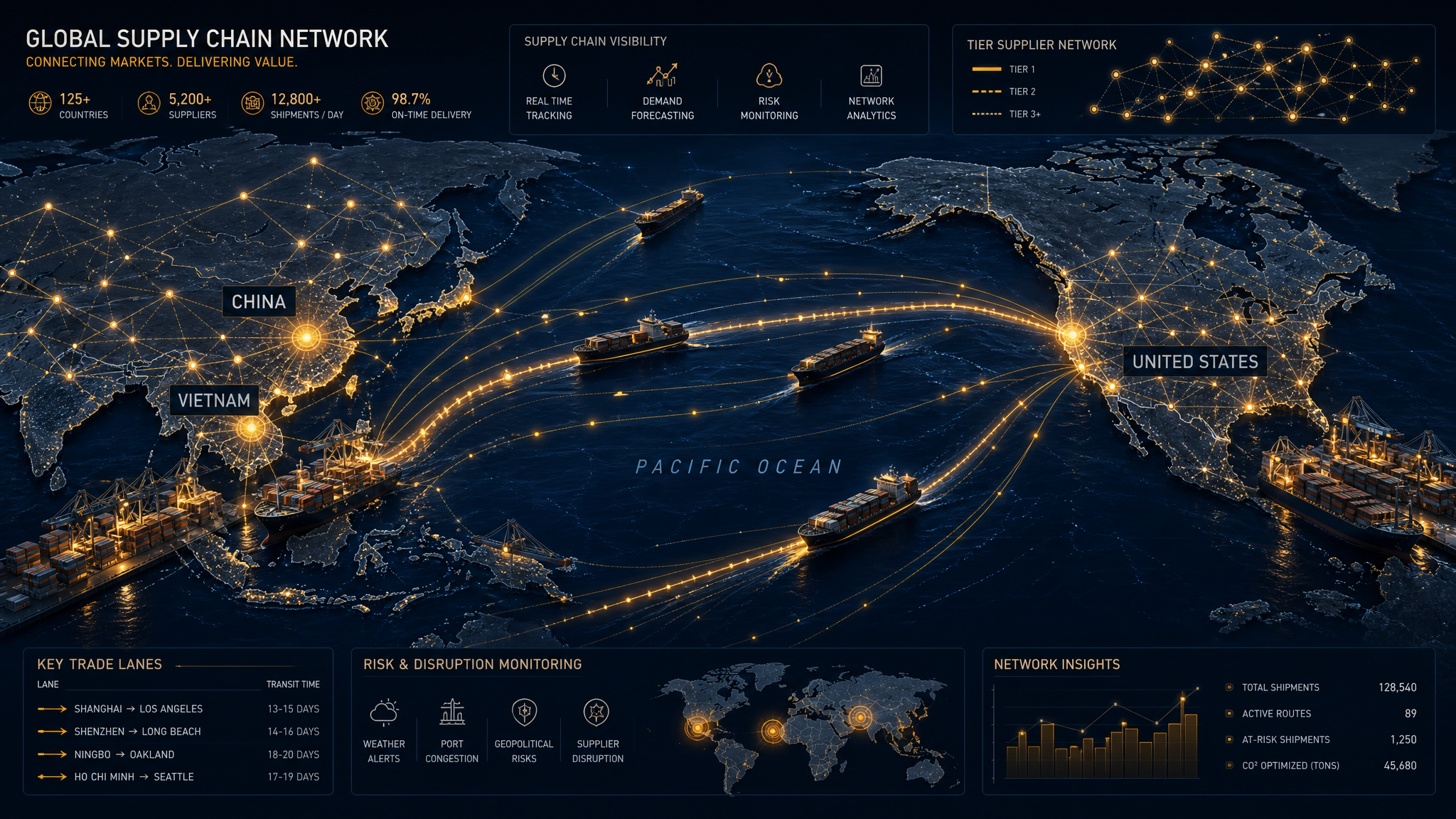
For the past several years, "China+1" has been the supply chain world's favorite prescription. Relocate final assembly to Vietnam. Open a factory in Mexico. Shift apparel production to Bangladesh. The logic seemed airtight: diversify away from China, sidestep Section 301 tariffs, and sleep soundly knowing your supply chain is de-risked.
The problem? For a growing number of companies, that sense of security is an illusion.
As U.S. Customs and Border Protection (CBP) and the Department of Justice ramp up enforcement against tariff circumvention, procurement leaders are discovering that moving final assembly is not the same as moving supply chain risk. The components, sub-assemblies, and raw materials feeding those new factories often still originate in China — and regulators are now equipped with the tools, the mandate, and the resolve to penalize companies that misrepresent where their products actually come from.
This is the rerouting illusion. And in 2026, it is becoming an expensive one.
What "China+1" Actually Means — and What It Doesn't
The China+1 strategy emerged as a rational response to a volatile trade environment. Driven by Section 301 tariffs imposed beginning in 2018, rising Chinese labor costs, and pandemic-era supply disruptions, companies began diversifying their manufacturing footprints. By 2023, 76% of U.S. companies with operations in China had explored or implemented some form of diversification. Vietnam became the go-to destination for electronics and apparel. Mexico attracted automotive and industrial manufacturers seeking USMCA advantages. India drew pharmaceutical and chemical producers.
The strategy makes intuitive sense at the finished-goods level. But it contains a structural flaw that most companies have been slow to confront: geographic diversification of assembly is not the same as decoupling from Chinese inputs.
No single country can currently replicate China's integrated industrial ecosystem — its scale, technical sophistication, and supplier network density are unmatched. As a result, the new manufacturing hubs in Vietnam, Thailand, and Mexico frequently rely on Chinese intermediate inputs. The "Made in Vietnam" label on the finished product may be technically accurate for the final assembly step, but the bill of materials often tells a very different story.
The Tier-2 and Tier-3 Blind Spot
Here is where the illusion becomes dangerous. Most companies have reasonable visibility into their Tier-1 suppliers — the factories they contract with directly. But research shows that only 42% of supply chain leaders have meaningful visibility into their Tier-2 suppliers and beyond. That blind spot is where the real China dependency lives.
Consider a simplified example: a U.S. electronics importer contracts with a Vietnamese assembler (Tier-1). That Vietnamese assembler sources printed circuit boards from a Taiwanese manufacturer (Tier-2). That Taiwanese manufacturer, in turn, sources its copper-clad laminates and specialty chemicals from Chinese producers (Tier-3). The finished product ships from Ho Chi Minh City, but its essential character was shaped in Shenzhen.
This pattern is not an edge case. It is the norm in sectors requiring specialized chemicals, advanced electronic components, processed rare earth minerals, and precision-machined parts — all areas where China maintains dominant global market positions. Chinese firms have also accelerated their own "+1" moves, building factories in Southeast Asia and Mexico while maintaining control of upstream inputs. A product assembled in a Chinese-owned factory in Vietnam from Chinese components is, for tariff purposes, unequivocally Chinese.
The Enforcement Gauntlet: CBP Is Catching Up
For years, enforcement lagged behind the scale of tariff circumvention. That era is over.
In August 2025, the DOJ and Department of Homeland Security launched a Trade Fraud Task Force to coordinate civil and criminal investigations into customs fraud. Reports to CBP's e-Allegations tipline surged by nearly 160% between March and May 2025 compared to the prior year — driven in part by a whistleblower incentive structure that pays tipsters 15% to 30% of government recoveries under the False Claims Act.
A July 2025 Executive Order established a punitive 40% ad valorem penalty tariff on goods CBP determines were transshipped to evade duties — with no mitigation or remission permitted. That means companies cannot negotiate the penalty down after the fact.
CBP's Enforce and Protect Act (EAPA) process allows investigators to impose interim measures — including cash deposit requirements and suspension of goods release — just 90 days into an investigation. The financial exposure is real and immediate.
Recent enforcement actions illustrate the stakes:
- Ceratizit USA LLC settled for $54.4 million in December 2025 for allegedly transshipping Chinese tungsten carbide products through Taiwan to evade Section 301 tariffs.
- Wanxiang America Corp. paid $53 million for misclassifying Chinese automotive components to avoid antidumping duties.
- MGI International LLC settled civil False Claims Act liability and saw its former COO plead guilty to conspiracy to smuggle goods — all over misrepresented Chinese plastic resin.
The message from Washington is unambiguous: ignorance of your sub-tier suppliers is not a legal defense.
The "Substantial Transformation" Test: A High Bar Most Companies Underestimate
The legal standard for determining a product's country of origin for tariff purposes is the substantial transformation test. A product is considered to originate from the country where it last underwent a process that created a "new and different article of commerce" with a distinct name, character, or use.
Simple assembly, repackaging, or minor processing consistently fail this test. In Uniroyal, Inc. v. United States, the court found that attaching an outsole to a shoe upper did not substantially transform the imported upper. In Energizer Battery, Inc. v. United States, assembling 50 prefabricated components into a flashlight was ruled insufficient because the components had a "predetermined use" and the process lacked sufficient complexity.
For companies using Vietnam or Mexico as final assembly locations, this creates a significant legal risk. If Chinese-made components dictate the product's essential character, CBP will likely determine the country of origin to be China — regardless of where the last screwdriver was turned.
When origin is genuinely ambiguous, the most defensible path is to seek a binding ruling from CBP before importing. A favorable ruling provides legal certainty. An unfavorable one, obtained proactively, at least allows you to restructure your supply chain before enforcement finds you.
Building Real Supply Chain Sovereignty: A Practical Framework
Moving beyond the rerouting illusion requires a deliberate shift in how procurement teams think about visibility, compliance, and cost.
Map beyond Tier-1. This is the foundational step. Mandate that Tier-1 suppliers disclose their own sourcing through contractual clauses requiring sub-supplier transparency and bills of materials. Supplement this with AI-powered supply chain visibility platforms that can centralize procurement data, flag hidden dependencies, and model origin risk across the full supplier network. Industry leaders like Walmart and DHL have demonstrated that real-time multi-tier visibility is operationally achievable — it is a question of investment priority, not technical impossibility.
Conduct rigorous origin analysis. For every product line shifted to a "+1" country, document a thorough substantial transformation analysis. Assess the complexity of the process, the value added in the new location, and whether key components lose their identity in the transformation. Do not rely on supplier self-certification alone.
Audit and self-disclose proactively. Regularly audit customs declarations for accuracy in classification, valuation, and origin. If internal audits uncover violations, consult trade counsel about voluntary self-disclosure (VSD). The MGI case shows that VSD does not eliminate civil liability — but it can prevent criminal prosecution and significantly reduce penalties.
Reframe the cost calculus. The lower unit price of a Chinese component is a false economy if it triggers a 25% Section 301 tariff plus a 40% transshipment penalty. Model the total cost of resilience — including potential tariffs, legal exposure, audit costs, and supply disruption risk — when evaluating sourcing decisions. For critical product lines, a "China+2" or "+3" approach, building redundancy across multiple regions, may be the only genuinely defensible posture.
Procurement teams that used the post-Lunar New Year capacity lull to diversify sourcing to secondary hubs will recognize this logic — as explored in our earlier analysis of post-Chinese New Year sourcing diversification windows, the same structural market shifts that create arbitrage opportunities also create compliance windows that disciplined teams can exploit.
What Procurement Leaders Should Do Right Now
The enforcement environment is not going to soften. Here is a practical checklist for the next 90 days:
- Identify your top 20 product lines by import value and conduct a rapid origin risk assessment for each. Flag any where final assembly occurs outside China but key components are Chinese-sourced.
- Review your Tier-1 supplier contracts for sub-supplier disclosure requirements. If they don't exist, add them at the next contract renewal — or sooner.
- Pull your EAPA exposure. If you import goods in categories that have been subject to antidumping or countervailing duty orders, assess whether your suppliers have been named in prior investigations.
- Engage trade counsel to evaluate whether any current import practices could be characterized as transshipment under the July 2025 Executive Order's broad definition.
- Evaluate supply chain visibility technology. The WTO's trade facilitation resources and CBP's Reasonable Care checklist provide useful frameworks for structuring your compliance program.
The Bottom Line
The China+1 strategy was never wrong — it was just incomplete. Moving final assembly out of China is a necessary first step, not a finished solution. In 2026, with a Trade Fraud Task Force actively pursuing cases, a 40% transshipment penalty with no mitigation, and whistleblower incentives driving a surge in tips, the cost of the rerouting illusion has never been higher.
The companies that will navigate this environment successfully are those that treat supply chain visibility as a compliance imperative, not a nice-to-have. Map your sub-tiers. Understand your origin exposure. Document your analysis. And do it before CBP does it for you.
The rerouting illusion is dissolving. The question is whether your supply chain strategy dissolves with it — or whether you've already built something more durable underneath.


Comments
Post a Comment